Product
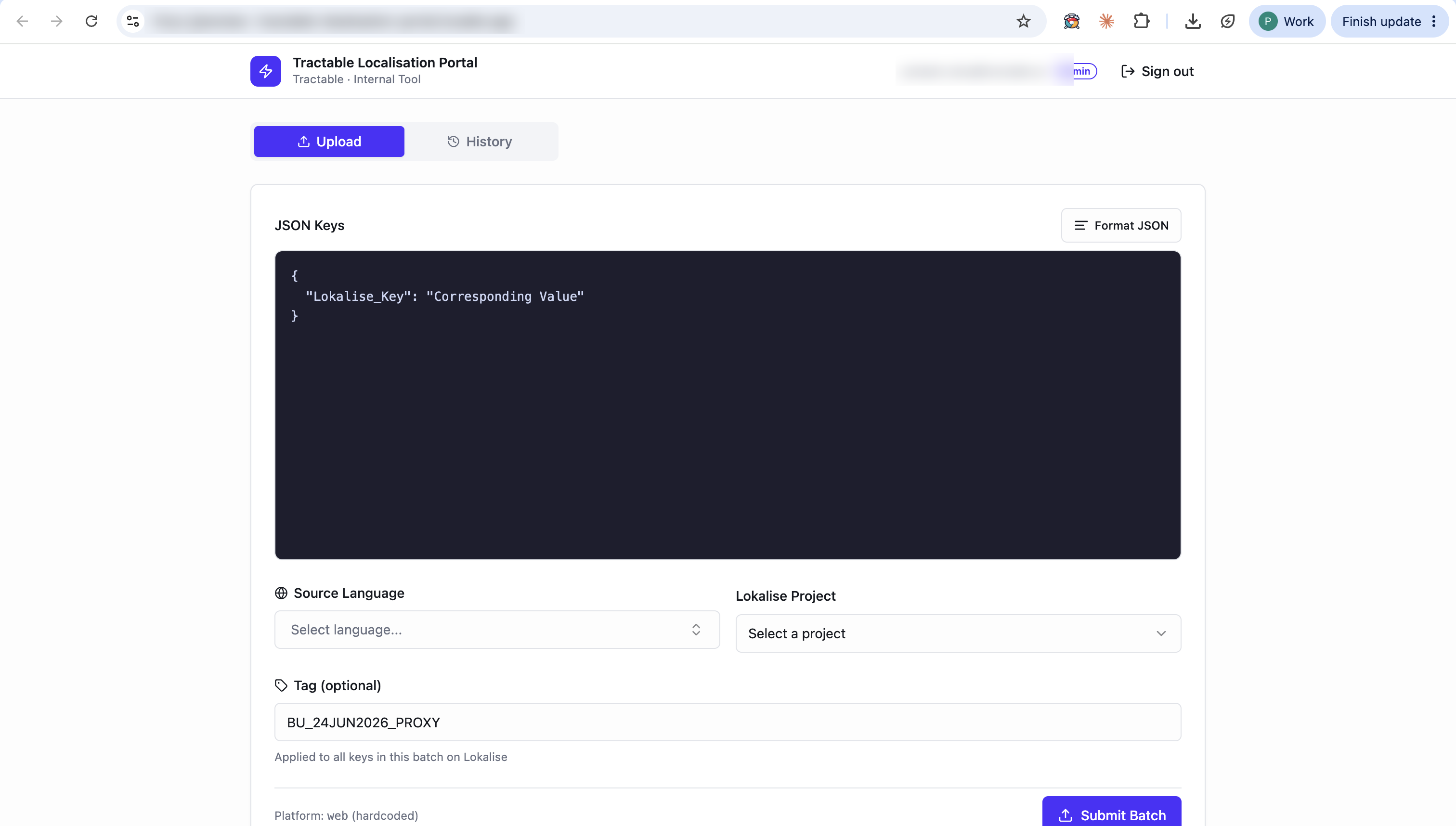
Upload screen
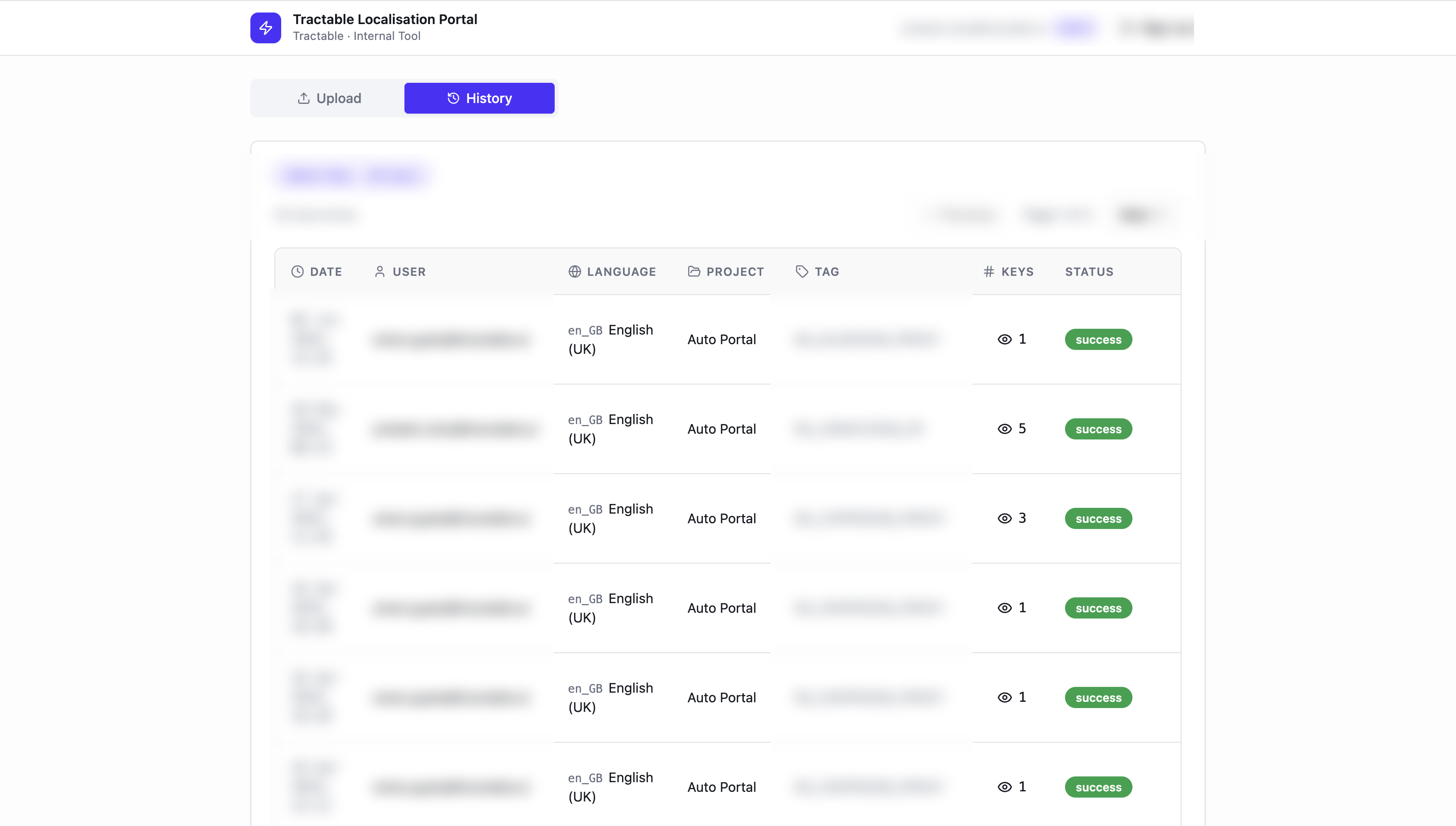
History screen
Estimate based on Lokalise's public pricing: Growth ($375/mo, 10 seats) → Advanced ($999/mo, 15 seats).
Context
I owned internationalization and localization for Tractable's new Auto Portal: every UI string added to the product needed to flow into Lokalise and come back translated into each required language. Lokalise was the team's source of truth for translation management, but project licensing capped the number of seats, and I held one of them.
Problem
Every key, from every engineer, had to go through me. I was the only person who could log into Lokalise and push new strings, which meant I was the bottleneck on a process that should have been routine. I raised it with leadership and asked about adding more seats; the answer was no, seats were intentionally capped to control the licensing bill. So more seats wasn't on the table, but the bottleneck still needed solving.
Options Considered
Approach
Reframed it as a build problem, not a budget problem
Engineers didn't actually need full Lokalise access; they needed one narrow action: submit a set of keys for a given language and project. That's a much smaller surface than a Lokalise seat, and it's one I could build without waiting on procurement.
Vibe-coded a working prototype in Lovable
Built a first version fast to test whether the interaction model actually held up: paste a JSON object of keys, pick the source language and target Lokalise project, optionally tag the batch, submit. I modeled it directly on Lokalise's own upload screen rather than designing a new flow from scratch, an interaction engineers already trusted, which is largely why it worked as expected from day one with no real iteration needed after launch.
Rebuilt it in Claude Code for production use
Once the workflow was validated, I rebuilt it properly: Tractable SSO so only employees could submit, a real Lokalise API integration in place of the prototype's stub, and a history view logging every submission by date, user, language, project, tag, key count, and status, so the proxy layer didn't trade one bottleneck for an untraceable one. I also drew a deliberate line at uploads, not deployments: the proxy pushes keys into Lokalise but never pushes translations live, and I kept that gate for myself on purpose, reviewing everything added each day so I could still catch anything that needed editing or removing before it shipped.
Hosted it inside Tractable's ecosystem and let it spread organically
No formal launch: I shared it with the engineers who kept pinging me for key uploads, and adoption spread from there as people saw it save them a round trip through me.
Learnings & Closing Words
- Not every bottleneck is a headcount or budget question. "We can't add seats" closed one door; it didn't close the actual problem, which was access to one specific action, not the whole tool.
- A disposable prototype is the fastest way to find out if a workflow idea is right. Before investing in hardening it, Lovable got me a yes/no answer in hours, not sprints.
- Self-serve only works if it's safe to grant. The audit trail wasn't an afterthought feature; it's what made it reasonable to open this up to anyone who asked for access.
- Drawing the scope boundary deliberately matters as much as building the thing itself. Keeping myself as the manual gate on deployment, rather than automating that too, was a conscious trade-off, not a gap I didn't notice. Automating that review safely is the natural next iteration.
The tool is still running. The bottleneck isn't.